
From Two Unsuccessful Attempts to IELTS Band 8.5: Toyin’s IELTS Journey for Canadian Immigration
Posted on September 25, 2026 by Scholar M. Alibo in IELTS & CELPIP
For many people planning to immigrate to an English-speaking country, proving your English proficiency is not simply an academic exercise. It can become one of the requirements standing between you and the immigration pathway you are pursuing.
Canada, Australia, New Zealand and the United Kingdom, among others, have immigration pathways in which applicants may need to demonstrate their English language ability. The specific test, score and level required vary depending on the country and the immigration program. IELTS is one of the most widely recognized tests used for this purpose, although it is not the only test accepted.
For someone applying through Canada's economic immigration system, for example, an approved language test can do more than satisfy a minimum eligibility requirement. Language results are entered into the Comprehensive Ranking System (CRS), where each of the four language abilities can contribute to a candidate's ranking. Higher language proficiency can also contribute to additional points through skill-transferability factors, depending on the candidate's other qualifications.
So for some applicants, the question is not simply: “Can I pass the English test?”
It is: “How high can I score?”
That distinction matters. And it brings us to Toyin.
“This Would Be My Third Time.”

When Toyin first contacted SLS Language, she was not preparing for her first IELTS test.
She was preparing for her third. Her words:
“This would be my third time and I need to get an overall band of at least 8.5. My last two results weren't so great. Can you help me?”
She had taken the IELTS General Training test twice the previous year. The first attempt was paper-based. The second was computer-based. Neither produced the result she needed.
What made the situation particularly frustrating was that Toyin did not feel she was struggling across the board.
“I don't know what happened with the reading and writing. I thought I had both down.”
She had already been trying to prepare on her own and her Speaking and Listening scores in the previous attempts were great. She had joined a Telegram group for support and had watched lots of YouTube videos. She had practised.
But something still wasn't clicking. And now she had another test ahead of her.
She Didn't Need to Start From Scratch
Before deciding how to approach the preparation, we wanted to understand what Toyin actually needed.
Was it more practice? Did she need someone to identify the small errors she was making repeatedly? Did she need more focused study? Was it a case of poor time management or lack of concentration?
Those are very different things. A student who already has strong English proficiency may not need to spend hours relearning grammar. They may need to understand why they are losing marks, recognize patterns in their mistakes and become more strategic about how they approach the test.
Toyin didn't need to be taught English from the ground up. Instead, the goal was to identify exactly what was standing between her current skills and her target score.
Then the Test Date Changed
Toyin had already booked her next test for August 24. Her schedule was not completely straightforward either. She worked different shifts and had to fit the lessons around her available days. We started planning the crash course around her schedule. Then, about a week later, she sent another message saying she had to postpone the test because of unforeseen circumstances.
Interestingly, the delay meant we no longer had to rush through the preparation.
There was more time to practise.
More time to review.
More time to identify and work on the areas that needed attention.
And over the next two months, that is what we did.
Two Months of Tailored Preparation
Toyin had already discovered what many IELTS candidates eventually discover: there is no shortage of IELTS materials. You can find practice questions online and join study groups. You can watch YouTube videos and download a wide range of vocabulary lists and sample answers. However, the difficult part is often knowing what to do with all that information. More material does not automatically mean better preparation.
Sometimes, what you need is someone who can look at your work and help figure out why you got a seemingly perfect response wrong. Is it a language problem? A comprehension problem? A timing issue? A misunderstanding of the task? Or a pattern that keeps appearing in your responses?
That was the purpose of the coaching. We didn't simply give this candidate more things to practise. We helped make her writing and reading practice more targeted.
Then Came the Result
After two months of tailored coaching, our test candidate sent me a message.
“I've received the result. Thank you very much for your help! I really appreciate it.” Then she shared the scores.
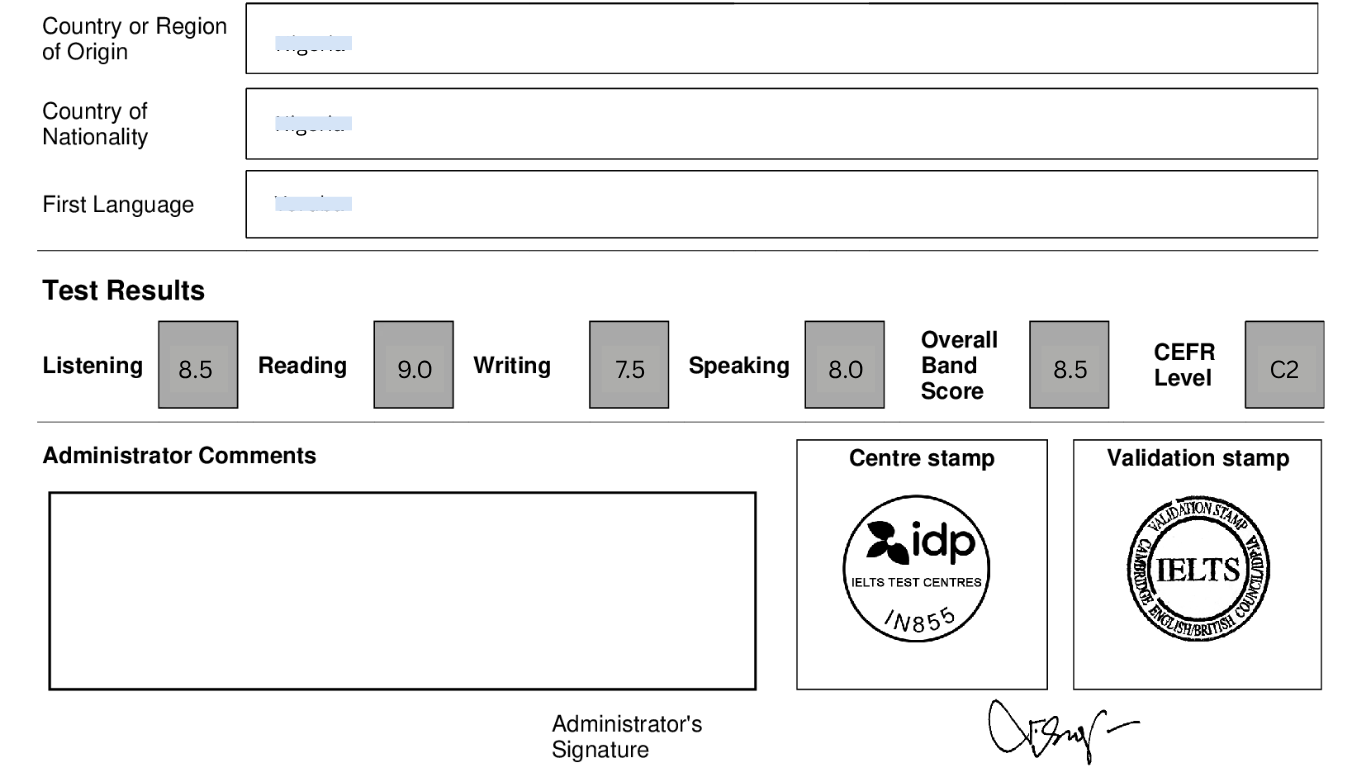
Speaking: 8.0 Listening: 8.5 Reading: 9.0 Writing: 7.5 Overall: 8.5
The target she had come to SLS with was an overall 8.5 and she got it!
Interestingly, the Reading section she had been so uncertain about ended up being her strongest result: 9.0. Writing, on the other hand, remained stubbornly at 7.5. When I congratulated her and joked that the writing section had remained “adamant,” she laughed.
“Lol. Yes. It's very stubborn. I was even expecting less but I'm glad.”
And honestly, she had every reason to be glad.
What a Band Score of 8.5 Really Represents
For Toyin, the 8.5 was not simply a number she wanted to see on an IELTS certificate. It was connected to a much larger goal: her Canadian immigration. For Express Entry candidates, language proficiency is one of the factors used to calculate the CRS score. Each of the four language abilities is assessed separately through the applicable benchmark system, so a candidate's Reading, Writing, Listening and Speaking results can all matter. Higher language proficiency can also interact with education and work experience to produce additional skill-transferability points. That helps explain why a candidate might aim considerably higher than the minimum language requirement.
Toyin was not simply asking, “Can I get the score required to qualify?” She was trying to achieve an English-language result that would strengthen an important part of her immigration profile.
And that is why her 8.5 matters.
Not because an 8.5 guarantees permanent residence. It does not. Immigration eligibility and ranking depend on multiple factors, and CRS cut-offs can vary between invitation rounds. But for her, every point she could earn from language proficiency mattered.
From “I Don't Know What Happened” to 8.5

When Toyin first reached out, she was coming from two disappointing attempts with one particularly frustrating question: “I thought I had both the reading and writing sections down.”
She had already studied and practised but had two unsuccessful attempts. What changed this time was the approach.
Instead of simply doing more, the preparation focused on identifying where she was losing marks and what she could do differently. Two months later, the result arrived: 8.5 overall.
As you might have noticed, not every section was perfect. Her Writing score was 7.5. But the result she had set out to achieve was there. And perhaps that is one of the more useful lessons from this test-taker's journey.
IELTS preparation is not necessarily about knowing everything, practising endlessly or achieving a perfect score in every skill. Sometimes, you need to understand your own performance well enough to stop guessing and start preparing with intention.
This student's journey ended with an 8.0. Yours may begin with identifying what is holding you back.
Comments (0)
Leave a Comment
No comments yet. Be the first to comment!